GBA Emulator - 90s Retro Games
- 4.7
- Rating
- 1.00M
- Installs
- Free
- Price

 Analysis by App-foxy
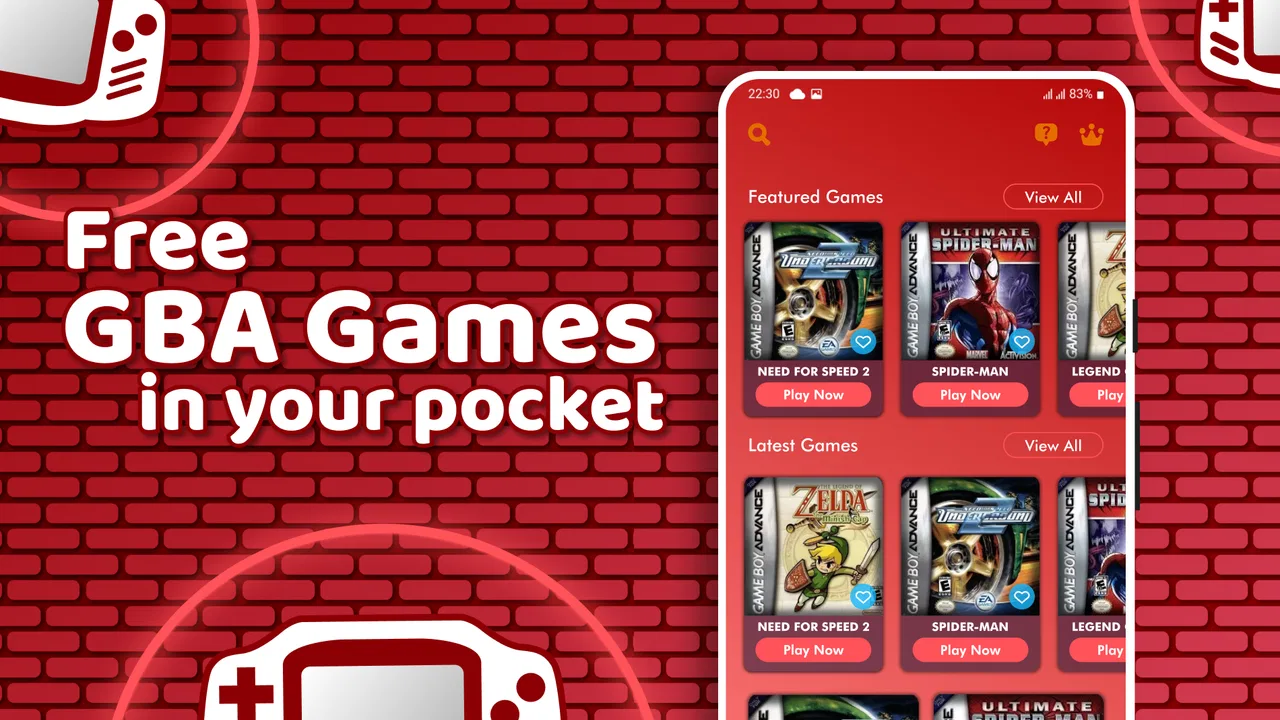
I spent time with GBA Emulator - 90s Retro Games as a compact way to revisit handheld-style arcade play, and my first impression was straightforward: it is most appealing when I want a quick retro session without turning the experience into a complicated setup project. The game is free to download, belongs to the arcade category, and is made by serplabmob. Its focus is emulation rather than modern presentation, so the appeal comes from familiar pixel-based play, simple controls, and the feeling of returning to an older generation of portable games.
The important distinction is that this is not a new arcade game built around original levels or a modern progression system. It is a Game Boy Advance emulator aimed at classic and DS-era experiences. That makes the quality of the experience depend on more than the app itself: the games you use, the phone or tablet you have, and how patiently you arrange the controls all matter. I found it best suited to people who already understand what an emulator is and want a convenient starting point, rather than to someone expecting a ready-made collection of contemporary games.
How I used it for ordinary retro sessions
My baseline workflow was deliberately simple. I opened the emulator, chose a game, adjusted the on-screen controls until my thumbs felt comfortable, and then played in short sessions before changing anything else. That approach matters because touch controls can feel awkward if you immediately try to reproduce the layout of a physical handheld without considering the size of your screen. On a phone held vertically, the controls can compete with the game image; on a larger display, the same arrangement may feel too spread out.
You May Also Like

 Blood Strike: 2.5 Anniversary
Blood Strike’s Loadouts Turn Every Drop Into a Tactical Gamble
A close look at Blood Strike’s custom loadouts: how fast access to signature weapons reshapes its battle royale rhythm, rewards preparation, and narrows the gap between fights.

 Pandora - Music & Podcasts
Pandora’s Music Is Easy to Start, but Harder to Recover
Pandora’s strength is its low-effort path from a seed to a station. Its weak spot is how much confidence it asks you to place in connection, setup, and quiet recovery.

 8 Ball Pool
 Is Built on Rivalries, Rematches, and Routine
A close look at the rivalries, rematches, shared routines, and unanswered safety questions that turn a quick pool match into a persistent mobile community.

 Samsung Music
’s Quiet Strength Is Playing What You Already Own
Its reach comes less from spectacle than from dependable access to a personal library. That simplicity is both the app’s strongest retention engine and its ceiling.

 AccuWeather: Weather Radar
AccuWeather Review: A Quick, Clear Forecast for Everyday Decisions
For everyday plans, the best forecast is the one you can understand quickly. AccuWeather makes rain timing, radar, and local conditions easy to act on, with a few trade-offs.

 Hill Climb Racing
Why Hill Climb Racing Still Turns Crashes Into One More Run
A tiny car, a bumpy hill and one more upgrade: Hill Climb Racing keeps resurfacing because its simple chaos makes every near-miss feel personal.
More From Our News Desk



I recommend starting with one familiar title rather than testing several games at once. A known game makes it easier to judge whether the issue is the emulator, the control placement, or simply the unfamiliarity of touch input. I also found that slower games are a better first test than fast action games. Platformers and reaction-heavy arcade titles quickly reveal whether your virtual buttons are too close together, while turn-based or menu-driven games give you time to settle in.
The app’s strongest everyday use case is a spare-minute session. I could play while waiting for an appointment or during a short break without needing a long tutorial or a large online account system. That immediacy is a real advantage over some modern retro collections that surround the game with menus, subscriptions, social features, or a heavy visual interface. Here, the attraction is the old-fashioned loop: choose a game, play for a while, and stop.
There is also a useful distinction between playing on a phone and playing on a tablet. A phone is more convenient, but the virtual buttons take up a larger proportion of the available space. A tablet gives the game image more room and can make the controls easier to see, although it is less comfortable for one-handed use. If you are choosing a device specifically for this kind of play, I would prioritize a comfortable screen and responsive touch input over raw power.
The store listing describes the app as suitable for everyone, which fits the uncomplicated nature of the interface and the family-friendly presentation. Still, “everyone” does not mean every player will enjoy it equally. Younger users may expect games to include modern tutorials and immediate progress systems, while older players may appreciate the lack of hand-holding. I would describe the age rating as reassuring for general access, but the actual suitability still depends on the particular game being played.
The app has reached over a million installs and holds a 4.7 average from around thirty-six thousand ratings, with 916 reviews shown alongside that reception. Those figures suggest that the basic idea connects with a substantial audience, but they should not be treated as proof that every game or every device will behave identically. Emulation is especially sensitive to the source material and hardware combination, so I judge it by how practical the workflow feels rather than by popularity alone.
The first settings I would check
Before trying to make the emulator look perfect, I would check the controls. This is the setting that changes the experience most immediately. Virtual buttons need enough separation for deliberate presses, but they should not force your hands into an unnatural position. I tend to place the buttons where my thumbs naturally rest, then play a short section that requires movement, jumping, and repeated taps. If I miss inputs because my thumb is sliding across neighboring buttons, the layout needs attention before anything else.
Screen orientation is another practical choice. Portrait mode is convenient for quick use and leaves the phone easy to hold, but landscape mode usually gives a more convincing handheld-style layout. I prefer landscape for longer sessions because the game image and controls feel less compressed. For a short break, portrait can be perfectly acceptable, especially when I do not want to hold the phone with both hands.
Visual preferences are worth adjusting only after the controls feel reliable. Retro games are designed around small, sharp images, and excessive smoothing can make them look soft. On the other hand, a completely unfiltered image may look harsh on a modern display. I usually compare the available presentation choices with the same game paused on screen, rather than deciding from a menu label. The right choice depends on whether you value crisp pixels or a gentler appearance.
Sound deserves a quick check as well. Older games often use short, repetitive effects and compact music loops, which can become tiring at a higher volume. I prefer keeping the game audio low enough that it supports the session without dominating it. This is also useful when playing in public or during a break at work. A small adjustment here can make the difference between a relaxing retro session and one that feels noisy after a few minutes.
Because the current version is 1.2.74, I would make a habit of checking whether the app has updated before spending time troubleshooting a problem. That does not guarantee that every compatibility issue disappears, but it is a sensible first step when an emulator behaves unexpectedly. I would also avoid changing several settings at once. If the image, sound, and controls all change together, it becomes difficult to know which adjustment actually helped.
The free entry point is useful for trying the experience without committing money. There are in-app purchases ranging from $1.99 to $29.99 per item, so I would look carefully at any purchase screen and decide whether the extra option is relevant to my own use before confirming it. For me, the sensible approach is to test the basic workflow first. If the controls and game handling already meet my needs, there is no reason to buy something simply because it appears in the interface.
Habits that make short sessions smoother
Experienced emulator users usually save time by repeating the same setup instead of rebuilding it for every game. My most useful habit was to create a consistent control arrangement and resist moving buttons around constantly. Once the layout becomes familiar, muscle memory starts to help. Switching the positions for every title may seem attractive because different games use buttons differently, but it can create more confusion than it solves.
I also recommend separating “testing” from “playing.” During testing, I check movement, menus, audio, and any important button combination. During playing, I stop adjusting things unless there is a genuine problem. This prevents the common emulator trap of spending more time tuning the screen than enjoying the game. A short test is enough to discover whether a particular title feels comfortable on the device.
For games with frequent menu use, I pay attention to how easily I can reach the buttons without covering the action. That sounds minor, but it matters in older handheld games where inventory, dialogue, or map screens may be central to the rhythm. A layout that works beautifully for a fast platformer may be irritating for a role-playing adventure. I would rather make a small compromise in the action area than place menu-related controls where they are easy to press accidentally.
Another useful pattern is to use a familiar game as a calibration tool whenever I move to another device. I do not need to guess whether the touchscreen feels responsive if I can repeat the same opening sequence and compare the result. This is more reliable than judging the emulator from a static menu. It also helps identify whether a problem comes from the phone’s touch response, the screen size, or the control arrangement.
I would keep sessions short when using demanding touch controls. A game that feels comfortable for ten minutes may become tiring after an hour, especially if the virtual buttons require a firm grip. The app works well as a pocket-sized diversion, but players seeking long evening sessions may prefer a physical controller or a dedicated handheld. That is not a failure of this particular emulator; it is a limitation of playing button-heavy games on a flat touchscreen.
When comparing it with the usual alternatives, I see three broad choices. A modern retro collection is often easier for beginners because the games, menus, and presentation are packaged together, but it may offer less flexibility. A dedicated handheld gives the most authentic physical control and is usually more comfortable for long play, though it requires another device. Other emulator apps may provide deeper configuration, but that extra control can make them feel intimidating. This app sits closer to the accessible middle: more direct than a full gaming platform, but less tactile than real buttons.
Where the emulator’s flexibility reaches its limit
The main limitation is that emulation is not the same as owning a curated game library. The app provides the emulator experience, while the overall usefulness depends on having games that you are legally entitled to use and that work properly with the app. I would not choose it if I wanted an instant, officially packaged catalogue with guaranteed compatibility. A licensed collection is a better fit for that expectation.
Compatibility can also vary from one game to another. A simple title may feel excellent, while a more demanding or unusual game may reveal graphical, audio, or input quirks. I would avoid assuming that success with one title guarantees the same result everywhere. The practical method is to test the specific games you care about and decide from that experience, rather than downloading the app solely because a general emulator description sounds promising.
Touchscreen controls remain the biggest barrier for action-focused play. They are acceptable for casual use, but they do not reproduce the physical feedback of a directional pad. In games that require diagonal movement, rapid button combinations, or precise timing, I sometimes found myself blaming the control surface rather than my own reaction. If your priority is competitive precision, this is probably not the right tool. A controller-friendly setup or dedicated handheld would be a better choice.
I would also be cautious about treating a large screen as an automatic upgrade. More space can make the image clearer, but it can also force your hands farther apart and make the controls less natural. The best arrangement is the one that keeps your wrists relaxed and your thumbs close to the actions they use most. This is why I prefer gradual adjustments instead of copying someone else’s layout exactly.
Storage and organization are practical concerns too. A large collection can become difficult to browse, especially when several games have similar names or when you are switching between many unfinished sessions. I found it more enjoyable to keep a small rotation: one quick arcade-style game, one slower adventure, and perhaps one title reserved for longer sessions. That habit makes the app feel like a purposeful library rather than a crowded folder.
The purchase range also means that budget-conscious users should pay attention during setup. The free version is enough to evaluate the core experience, but optional spending can become less obvious when you are eager to improve the session. I would only consider a purchase after identifying a specific problem it solves. If the issue is uncomfortable touch control, for example, buying an unrelated add-on will not change the physical limitations of the screen.
Who will enjoy it most
I would recommend this arcade game to someone who already enjoys retro handheld design and wants a convenient way to play on a current Android device. It is especially suitable for short sessions, familiar games, and users willing to spend a few minutes arranging the controls. The low barrier to trying it is valuable: you can explore the basic experience for free before deciding whether it belongs in your regular rotation.
It is also a reasonable option for people who want a less cluttered alternative to modern gaming apps. There is no need to learn a large social system or work through a complicated progression model before reaching the game. The appeal is immediate access to an older style of play. For someone who remembers Game Boy Advance-era design, that simplicity may feel refreshing rather than limited.
I would skip it if I expect a polished, officially licensed catalogue ready on the first launch. I would also look elsewhere if I mainly play fast competitive games, need perfect physical-button accuracy, or dislike adjusting settings manually. A dedicated handheld or a controller-based solution will be more comfortable in those situations. Likewise, complete beginners who do not understand game files or emulator workflows may prefer a packaged retro collection with clearer guidance.
One realistic scenario is a commuter using a phone during a ten-minute wait. I would choose a familiar game, keep the screen in the orientation that leaves the controls easiest to reach, lower the sound, and play a section that does not require a long uninterrupted commitment. That is where the app makes the most sense. It turns a phone into a quick retro break without demanding a full gaming setup.
Another scenario is a parent introducing an older handheld style to a child. The Everyone rating and straightforward arcade presentation make the app approachable, but I would still choose the game personally and supervise purchases. The rating describes the general app presentation, not every possible piece of content a user might load into an emulator. That small distinction is worth remembering in a family setting.
My verdict after building a repeatable routine
After settling on a control layout, checking orientation and sound, and keeping my game rotation small, I found the experience much more enjoyable than during my first unstructured tests. The app rewards a little preparation. It is not about discovering a hidden system of complex features; it is about making a few sensible choices and then leaving them alone long enough for the controls to become familiar.
The best reason to use this emulator is its balance between quick access and retro flexibility. It is easier to approach than a highly technical emulator, while still offering the basic kind of control that retro players expect. Its weaknesses are equally clear: touchscreen input cannot fully replace buttons, compatibility may vary by game, and the app is not the same as a ready-made licensed library.
With a 4.7 average and more than a million installs, it has clearly found an audience, and I understand why. The free starting point makes experimentation easy, while the arcade focus keeps the experience direct. I would treat the optional purchases carefully, test the games that matter to me, and avoid expecting every title to feel identical.
My final recommendation is therefore conditional but positive. If you want convenient Game Boy Advance-style sessions on Android and are comfortable doing a small amount of setup, this is a worthwhile place to begin. If you want long, precise play with physical controls or a fully curated catalogue, choose a dedicated alternative instead. For everyone in between, GBA Emulator - 90s Retro Games works best when used with a repeatable routine: arrange the controls once, check the important settings, keep expectations realistic, and let the simplicity of retro play do the rest.
FAQs for GBA Emulator - 90s Retro Games
01What devices are compatible with GBA Emulator - 90s Retro Games?
GBA Emulator - 90s Retro Games is designed for both Android and iOS devices. It requires Android 4.1 or higher and iOS 10.0 or later. Make sure your device meets these requirements to ensure smooth performance and compatibility with most retro games.
02Are there any in-app purchases or ads in GBA Emulator - 90s Retro Games?
Yes, the app may contain ads and optional in-app purchases. While the basic emulator is free, you might encounter ads during gameplay. In-app purchases can enhance your experience by removing ads or unlocking premium features, but they are not necessary to enjoy the core functionalities.
03Can I use GBA Emulator - 90s Retro Games offline?
Absolutely! GBA Emulator - 90s Retro Games allows you to play your favorite retro games offline once they are downloaded onto your device. This makes it convenient for gaming on the go without requiring an internet connection, ensuring uninterrupted gameplay.
04How do I load games onto GBA Emulator - 90s Retro Games?
Loading games onto the emulator requires you to have ROM files of the games. These files can be imported into the app through your device’s storage. Ensure that you are legally allowed to download and use these ROMs, as downloading copyrighted content without permission is illegal.
05Does GBA Emulator - 90s Retro Games support multiplayer gaming?
Currently, GBA Emulator - 90s Retro Games primarily focuses on single-player experiences. However, some updates may include multiplayer features through local or online connectivity. Keep an eye on app updates for any new features that could enhance the gaming experience, including multiplayer options.
Pros
- Wide range of classic games available.
- User-friendly interface for easy navigation.
- Smooth performance with minimal lag.
- Customizable controls enhance gameplay.
- Supports save states for progress retention.
Cons
- Occasional crashes on older devices.
- Limited multiplayer functionality.
- Ads can be intrusive at times.
- Some ROMs may not load properly.
- No built-in ROM download feature.

GBA Emulator - 90s Retro Games
Gallery